
The Suffolk Moth Group volunteers visited Rougham Estate Trust woodland for the fourth consecutive year, this time surveying a new wood – Elm Wood – for one night-time survey on 13th July 2024. A mercury vapour trap (MV) and actinic light moth trap was used along the track and in the small area of woodland. In total, 93 species of moth were recorded that night, 16 of which were new to the estate list. The species total for the estate now stands at 401 species.
The following moth species are worthy of note:
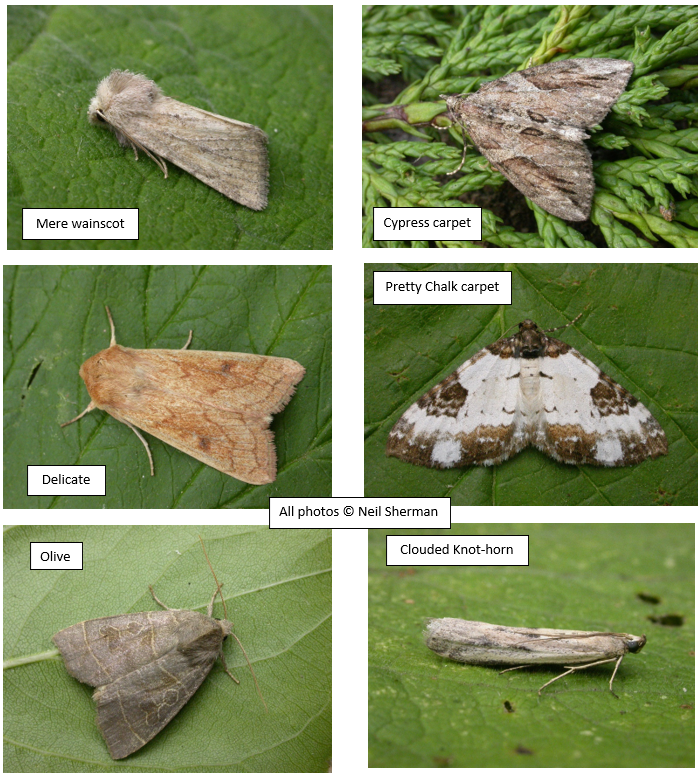
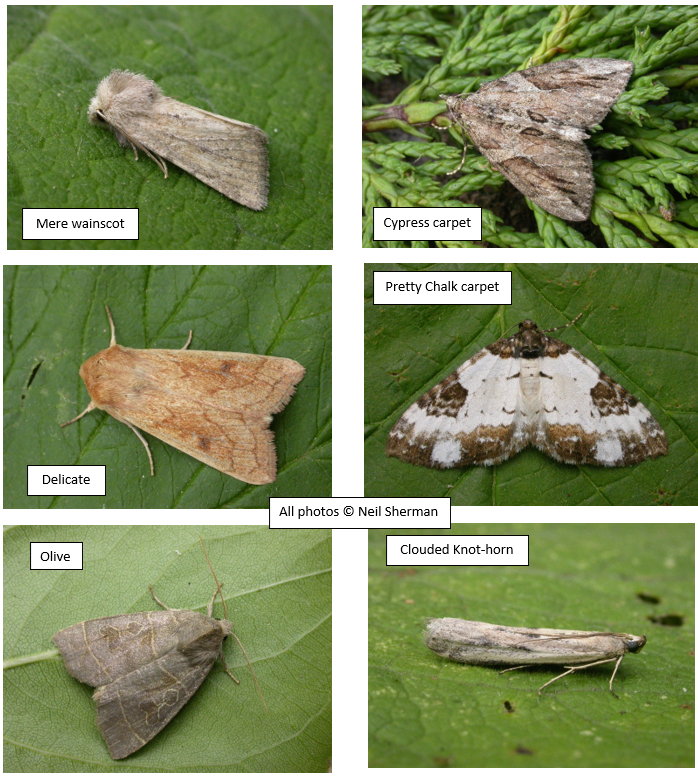
- Clouded Knot-horn (Homeosoma nebulella) – Nationally Scarce B – This is quite a scarce species in Suffolk, recorded in scattered locations mainly along the coast and in the Breck area, so was a particularly good find. The larva feeds in the flowers of thistles, ragwort and tansy.
- Cypress Carpet (Thera cupressata) – A recent colonist to Suffolk, first noted in 2010 and now increasing and spreading as a breeding species. It feeds as a larva on Leylandii, so this moth must have wandered to the site as there was no foodplant present near the traps.
- Pretty Chalk Carpet (Melanthia procellata) – A local species in Suffolk whose larvae feed on wild clematis.
- Mere Wainscot (Photedes fluxa) – Another local species, mainly found in the west of Suffolk. This grassland moth feeds on Wood Small Reed and is often found along woodland rides, as was the case at Rougham.
- Olive (Ipimorpha subtusa) – Local in Suffolk, widely scattered but declining. Larvae feed on poplars, so the species is mainly found in river valleys.
- Delicate (Mythimna vitellina) – A former scarce migrant grassland moth to the UK that in recent years appears to be establishing breeding populations at inland locations, possibly due to climate change. This inland site adds to the growing list where the moth has been found.
Rougham Estate Trust is committed to implementing recommendations that will benefit moths in woodland and other habitat management, most of which are similar to those that benefit butterflies, other insects and birds. The moth surveys will flag up priority species for conservation and help guide policy.
Rougham Estate Trust is very grateful to Neil Sherman and other Suffolk Moth Group volunteers who give their time to this project. Check out their excellent website https://suffolkmoths.co.uk/